
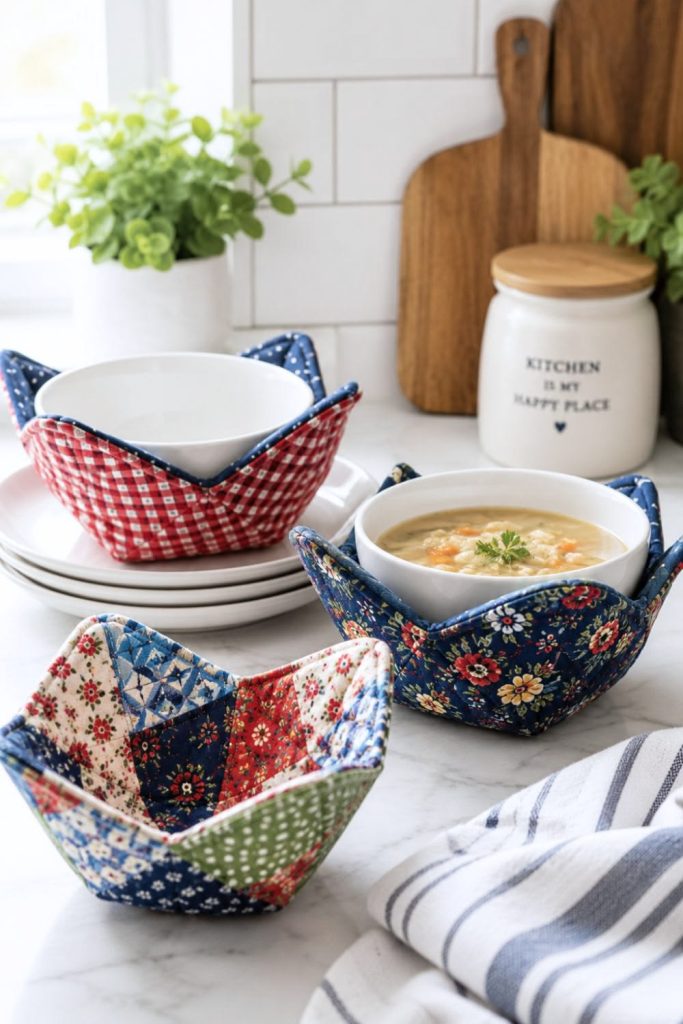
The Flower Bowl Cozy Tutorial is a practical and decorative quilting project designed to create a soft fabric holder that surrounds a bowl while forming attractive petal-like points around the edges. Inspired by the quilted bowl cozies shown in the photo, this project combines cotton fabric, batting, simple quilting, darts, and dimensional shaping to produce a useful accessory for the kitchen. The finished cozy can hold an appropriately sized bowl securely while also adding the handmade charm of a small quilted project to your table.
One of the most appealing features of this quilted bowl cozy pattern is its flower-inspired construction. Instead of producing an ordinary square holder, carefully placed darts transform flat quilted fabric into a three-dimensional bowl shape. The corners remain raised and create four prominent points that resemble petals. By coordinating the exterior and lining fabrics, you can create anything from traditional country-style cozies to modern versions made with solids, florals, gingham, or colorful fabric scraps.
This is also a wonderful project for quilters who want to use smaller pieces from their fabric collection. A Flower Bowl Cozy requires relatively little material, making it ideal for fat quarters and coordinated scraps. The sewing techniques are approachable for confident beginners, while experienced quilters can personalize the design with decorative quilting and patchwork. Because the project may be used around warm dishes, material selection is particularly important; if you intend to microwave the cozy, use materials specifically labeled by their manufacturers as microwave-safe and follow all applicable product instructions.
Materials, Measurements, and Preparing the Quilted Pieces
For one medium Flower Bowl Cozy, prepare two squares of 100% cotton fabric measuring approximately 11 x 11 inches (28 x 28 cm). One square will become the outside of the cozy and the other will form the lining. You can use matching fabrics or contrasting prints to emphasize the reversible construction.
You will also need two pieces of appropriate batting measuring approximately 11 x 11 inches (28 x 28 cm). For ordinary tabletop use, standard quilt batting can be selected according to your preference. If the finished item will be used in a microwave, however, every component—including fabric, batting, and thread—should be specifically suitable for that use according to the manufacturers. Avoid assuming that an unknown batting or decorative material is microwave-safe.
Basic sewing supplies include a sewing machine, cotton thread, quilting ruler, rotary cutter or fabric scissors, marking tool, pins or clips, and iron. A walking foot can make quilting easier because it helps feed the fabric and batting layers evenly, although a standard presser foot can also work.
Begin by pressing both fabric squares. Center one batting square against the wrong side of each fabric square. Quilt each fabric-and-batting unit independently. A simple diagonal X-shaped quilting design is excellent for beginners: stitch from one corner to the opposite corner and repeat across the remaining corners.
For more texture, add additional quilting lines approximately 1½–2 inches (4–5 cm) apart. The objective is to secure the batting without making the fabric excessively stiff. Consistent quilting also helps the finished bowl holder maintain its shape after repeated use and washing.
The suggested 11-inch square generally creates a cozy suited to many medium household bowls, but bowls vary significantly. Before making several cozies, complete one sample and test it with the specific bowl you intend to use. For a larger bowl, begin with a 12- or 13-inch (30.5–33 cm) square and adjust the darts proportionally.
Creating the Darts and Flower-Shaped Bowl Structure
Once both quilted squares are prepared, the next step in this Flower Bowl Cozy Tutorial is dimensional shaping. Fold the first quilted square in half with the fabric side facing inward. Carefully align the edges and mark the midpoint of the folded edge.
Starting at the midpoint, mark a dart approximately 1 inch (2.5 cm) wide at its widest point and 2¼–2½ inches (5.7–6.4 cm) long. Draw a tapered line from the edge toward the interior so the dart gradually narrows to nothing. Stitch directly along this marked line.
Repeat on the opposite side of the folded piece. Next, open the piece, rotate it 90 degrees, and fold it in half again. Mark and sew another pair of darts. You should now have four evenly distributed darts, which cause the square to curve upward naturally.
Repeat exactly the same process on the second quilted square. Consistency is important because the exterior and lining must fit together smoothly. If one set of darts is noticeably deeper than the other, the two sections may wrinkle when assembled.
Trim the excess fabric from each dart, leaving approximately ¼ inch (6 mm) beyond the stitching. Do not cut too close to the seam. Finger-press or carefully press the dart allowances in alternating directions to reduce unnecessary bulk when the two bowl-shaped pieces are nested together.
Place one shaped piece inside the other with right sides together. Match the corners, darts, and edges. The four corners will naturally extend outward, creating the beginning of the distinctive flower appearance. Clip around the perimeter and check that both layers sit smoothly before sewing.
Sewing, Turning, and Forming the Flower Petals
Sew around the entire outer edge using approximately a ⅜-inch (1 cm) seam allowance, but leave a turning opening measuring about 3 inches (7.5 cm) along one relatively straight section. Backstitch at both ends of the opening so the stitches do not loosen during turning.
Before turning, carefully trim bulky areas around the corners. Avoid cutting through the stitching. Small clips in the seam allowance around curved or heavily shaped sections can also help the finished edges lie smoothly.
Turn the entire quilted bowl holder right side out through the opening. Work slowly so the opening does not stretch. Use a blunt turning tool, knitting needle, or similar object to gently push the four corners outward. Avoid sharp tools that could puncture the fabric.
Once turned, manipulate the seams with your fingers until the outer edge looks even. The four extended corners should resemble broad petals surrounding the center bowl area. Press the piece carefully, paying particular attention to the turning opening.
Fold the raw edges of the opening inward so they align with the sewn seam. Clip them closed. Then topstitch approximately ⅛ inch (3 mm) from the outer edge around the entire cozy. This closes the opening while creating a neat, durable finish.
You can add a second line of topstitching approximately ¼–⅜ inch (6–10 mm) inside the first for extra definition. Decorative quilting around each petal can also emphasize the flower bowl cozy design, but avoid excessive embellishments if the holder will be exposed to heat.
Finishing, Customizing, and Using Your Bowl Cozy
Place the finished cozy on a flat surface and insert the bowl you plan to use. The center should settle beneath the bowl while the four quilted corners rise around it. If the bowl floats too high, your darts may need to be slightly deeper on your next version. If the cozy is too tight, use shallower darts or a larger starting square.
For a scrappy Flower Bowl Cozy, construct each main square from smaller fabric pieces before adding the batting. Patchwork squares, strips, or simple four-patch arrangements work beautifully. After piecing, trim the completed panel to the required starting dimensions and proceed with the same quilting and shaping method.
Color combinations can completely change the personality of the project. Navy floral with red gingham creates a traditional country look similar to the inspiration, while sage green and cream offer a softer farmhouse style. Bright scraps can create cheerful everyday cozies, and coordinated seasonal fabrics make attractive handmade gifts.
You can also create a complete set in several sizes. For example, start with approximately 9-inch (23 cm), 11-inch (28 cm), and 13-inch (33 cm) squares to experiment with holders for smaller and larger bowls. These are starting points rather than universal sizing because the final fit also depends on dart depth and bowl geometry.
Washable materials make the project especially practical. Follow the care recommendations for the specific fabrics and batting you selected. Prewashing cotton fabric before construction can help minimize unexpected shrinkage later, particularly when combining fabrics from different manufacturers.
When using any handmade textile around heat, inspect it regularly for wear, scorching, exposed batting, metallic decoration, or damaged seams. A fabric cozy is not a substitute for cookware designed for direct heat, and it should never be used on a stovetop, under a broiler, or near an open flame.
FAQ About the Flower Bowl Cozy Tutorial
What size fabric do I need for a bowl cozy?
For a medium version, two 11 x 11-inch (28 x 28 cm) fabric squares and two matching batting squares provide a practical starting point. Adjust the dimensions according to your bowl.
Why does a bowl cozy need darts?
The darts create the three-dimensional shape. Removing a small amount of width at four positions allows the flat quilted square to curve upward and surround the bowl.
How do I make the corners look like flower petals?
Keep the corners extended instead of rounding them away. When the darts pull the sides upward, those corners naturally become raised points resembling petals.
Can I make the Flower Bowl Cozy reversible?
Yes. Because two finished quilted sections are sewn right sides together and turned, attractive fabrics can be used on both sides.
Can I use fabric scraps?
Absolutely. Sew scraps together first to create panels slightly larger than your required squares. Press them, trim them to size, add batting, and continue with the tutorial.
What seam allowance should I use?
Approximately ⅜ inch (1 cm) works well around the outer perimeter. A consistent seam allowance is more important than choosing an exact measurement.
Can I microwave a handmade bowl cozy?
Only when the fabrics, batting, thread, and any other components are explicitly suitable for microwave use according to their manufacturers. Do not use metallic fabrics, metallic threads, or unknown materials in a microwave. Follow the microwave and material manufacturers’ safety guidance.
Why is my finished cozy too flat?
The darts may be too shallow. Slightly deeper or longer darts create stronger curvature.
Why is my bowl cozy too small?
The original square may be too small for your bowl, or the darts may remove too much volume. Increase the starting dimensions or reduce the dart depth on your next version.
Should I prewash the fabric?
Prewashing is useful when working with cotton because it reduces the possibility of shrinkage after the completed cozy is washed.
Can I sell finished bowl cozies made from this type of project?
Handmade bowl holders are popular craft-fair items. If selling them, accurately describe the materials and avoid making unsupported heat- or microwave-safety claims.
Is this project suitable for beginning quilters?
Yes. It provides useful practice with basic quilting, darts, layered construction, turning, topstitching, and accurate seam matching without requiring a large quilt.
Conclusion
The Flower Bowl Cozy Tutorial combines the usefulness of a fabric bowl holder with the decorative character of a small quilt project. Two quilted fabric squares, four carefully positioned darts, and simple layered construction are enough to transform flat fabric into an attractive three-dimensional cozy with distinctive flower-like corners.
This project is particularly enjoyable because it offers so many opportunities for personalization. You can use coordinated floral prints, gingham, traditional quilting cotton, or an assortment of favorite scraps. You can also make several sizes and create matching sets for your kitchen or handmade gifts.
Most importantly, careful cutting, even darts, consistent quilting, and neat topstitching will give the Flower Bowl Cozy a polished finish. Once you understand the basic construction, it becomes an easy pattern to repeat and customize, making it a useful addition to any collection of beginner-friendly quilting and sewing projects.